New Music + Video: Farabale - Brainjo @iam_brainjo


BRAINJO – FARABALE | @iam_ brainjo Jonathan Anaeto Chukwudebe "Brainjo" formerly known as Black J, is an Afro Pop, Highlife and Reggae Dancehall Artiste, he was born and raised in Shendam near Jos Plateau State 28 years ago. The Ihiala Anambra state born fast rising Artiste lost his parents 23 years ago at a very young age. As an ambitious lad, on December 2003, Brainjo move down to Lagos State in pursue of greener pasture, he has been on the street of Lagos for over fourteen years, doing all manner of jobs just to raise money to record his songs. He recorded his first music single "African beauty in 2005 with the late Ojb Jezreel of blessed memories. In 2009 he tried again by recording three singles, “Pitty drivers”, “Party with me” and “Mummy why” produced by J-Martins. Brainjo appeared on major newspapers and magazines with interviews and reviews as (Black J ) in 2007/2009 respectively. In 2011 he recorded a song "Want to do" which was produced by Meca E. To crown it all, Brainjo tagged the year 2017 as "My Year of Breaking Barriers". Brainjo never give up on his dreams, he made a come-back with a new music single titled “Farabale” which was produced by DTunes. You can follow Brainjo on Twitter and Instagram @iam_ brainjo. To view the new

                                                                       Download Audio
                                              DOWNLOAD FARABALE BY BRAINJO


Monday, 29 April 2019

11-Year-Old Kid From Nigeria Creates Hyperrealistic Drawings, And The Result Will Blow Your Mind

April 29, 2019

11-Year-Old Kid From Nigeria Creates Hyperrealistic Drawings, And The Result Will Blow Your Mind

hopefornigeriaonline.com

Meet Kareen Waris Olamilekan (also known as Waspa), an 11-year-old artist from Lagos, Nigeria, who is quickly gaining international recognition for his life-like drawings.

This talented young man is currently studying at Ayowole Academy of Arts, calls himself a “bitty artist”, and dreams about seeing his works in a museum someday.

Olamilekan has been drawing since the age of 6, and the main subject of his hyperrealistic works is usually portraits, although he sometimes goes beyond them, too. “I draw my friends. I draw cartoons, comics. I draw illustrations from textbooks and newspapers,” Olamilekan told BBC. “I draw hyperrealistic pencil works.”

Every drawing that Kareen creates stuns us with the details that are not something very common for an 11-year-old. Kareen says that his inspiration comes from everything that’s happening around him, especially his family, but also he reflects a lot on two of his artistic idols – Nigerian artist Arinze Stanley, who also specializes in hyperrealism, and Italian Renaissance master Michelangelo.

The most famous artwork that Olamilekan created is called “Daily Bread” – it depicts a person eating in sweat and tears. “My family, we work hard before we put food in our mouths, before we eat,” explains Kareen. “That’s what inspires me.”

This is Kareen Waris Olamilekan, an 11-year-old artist from Lagos, Nigeria

He’s quickly gaining international recognition for his life-like drawings

This talented young man is currently studying at Ayowole Academy of Arts

He calls himself a “bitty artist”, and dreams about seeing his works in a museum someday

Olamilekan has been drawing since the age of 6

The main subject of his hyperrealistic works is usually portraits, although he sometimes goes beyond them, too

“I draw my friends. I draw cartoons, comics. I draw illustrations from textbooks and newspapers”

Every drawing that Kareen creates stuns people with the details that are not very common for an 11-year-old

Kareen says that his inspiration comes from everything that’s happening around him, especially his family

He also reflects a lot on two of his artistic idols – Nigerian artist Arinze Stanley and Italian master Michelangelo

The most famous artwork that Olamilekan created is called “Daily Bread”

It depicts a person eating in sweat and tears

“My family, we work hard before we put food in our mouths, before we eat,” explains Kareen

“That’s what inspires me”

Although Kareen is using social media for not that long

He’s already counting almost 38k followers on Instagram who are stunned by his artworks

What a talented young man!


JAMB to review 687 CBT centres' reports before releasing UTME results

April 29, 2019

JAMB to review 687 CBT centres' reports before releasing UTME results

thenationonlineng.net

Apr 30, 2019 12:01 AM

The results of this year’s unified tertiary matriculation examination (UTME) will be released as soon as reports from the 687 Computer-Based Test centres used for the conduct of the examination are reviewed, the Joint Admissions and Matriculation Board, has said.

The board said the review of reports from the centres would be concluded either Monday (yesterday) or Tuesday (today).

JAMB spokesperson Dr. Fabian Benjamin, who addressed reporters yesterday in Abuja on the issue, attributed the delay in releasing the results to fraudulent practices by some candidates.

The UTME was conducted between April 11 and 17.

Benjamin said some candidates abused some of the innovations introduced by the board, making it necessary to properly screen the UTME results to ensure that the board does not release the results of a compromised examination.

He said: “We are comparing reports from the field, and as soon as we finish – either today or tomorrow – we will commence the process of releasing the results.

“We are collecting reports from 687 centres. The results will be released as soon as we finish what we are doing.”

The JAMB spokesman also said the board would investigate issues bordering on biometric failure during the conduct of the examination.

There were reports of biometric verification challenge in some centres during the examination.

Benjamin said the board would look into it as soon as it finishes releasing the UTME results to ensure that candidates with genuine biometric issues are not made to suffer.

According to him, if a candidate could be captured during registration, there is nothing stopping the fingerprints of such candidate from being captured during the examination.

“As soon as we finish releasing results, we will look into it. If there is any candidate with genuine reason, we will see what we can do.

“We will investigate all issues of biometric verification. If we find the cases to be genuine, we will do the needful,” he said.


Sunday, 28 April 2019

This Man Knew He Was Being Scammed on the Internet. What He Did Next Changed His Scammer’s Life

April 28, 2019

This Man Knew He Was Being Scammed on the Internet. What He Did Next Changed His Scammer’s Life

Apr 28, 2019 11:43 PM

An online con 
goes wonderfully, 
implausibly right.

From target and scammer to business partners and friends: Ben Taylor (left) and Joel Willie Courtesy Ben Taylor From target and scammer to business partners and friends: Ben Taylor (left) and Joel Willie

One day in the winter of 2017, Ben Taylor received this random Facebook message: “My name is Joel from Liberia, 
West Africa. I need some assistance from you. Business or financial assistance dat [sic] will help empower me.”

No one likes Internet scammers, Taylor included. So the 32-year-old marketer from Ogden, Utah, insincerely responded, “How can I help?”
“I wanted to see how this whole scam operation worked and how they bait people,” Taylor explains. “I just wanted to go down this rabbit hole and see what are the tricks that they use to get people.”

But there’s no way he could have guessed what would happen next. Joel Willie was indeed in Liberia, and he proposed a business partnership. He asked Taylor to mail some used electronics to an address in New Jersey. Supposedly the electronics would be resold and the profits split between the two of them.

“I looked the place up on Google Earth,” Taylor says. “There were broken-­down cars all over the place.” He wrote back to Willie and told him he was skeptical. Willie insisted he would never take advantage of someone. “­Bible says in Proverbs 22 a good name is better than silver n gold,” he wrote.

Taylor didn’t buy it, and he replied with a small lie of his own. “I figured the more time of theirs that I can waste, the less time that they’d have to spend ripping me or other people off.”

He told Willie he owned a photography business and could use some pretty pictures.

“How about a nice Liberian sunset?” Taylor asked.

Was Taylor planning on paying for the photos? Willie wanted to know.

“If they’re good, sure,” Taylor said.

Willie wasted no time. He snapped a couple of sunset photos on his old dinosaur flip phone and sent them to Taylor’s phone the next day.

“I told him, ‘Hey, this is great,’ ” Taylor says. Another fib—he wasn’t even sure it was a sunset in the photos.

Willie said he could take better pictures if he had a better camera. Taylor decided to play along and see what happened. So he picked up the cheapest camera he could find—a shiny red one—and shipped it off to Liberia. The postage cost as much as the camera. And now Taylor was really invested in this—whatever it was. “My family thinks I’m crazy because I’m interacting with this guy in Liberia,” he says.

Willie kept in close touch, telling Taylor he wanted to be a journalist. He wrote, “I’ve decided 2 really commit n devote myself 2 dis business, what other pictures you want me 2 take?”

Still skeptical, Taylor said he’d like to see 20 shots of life in Liberia. A week later, a bunch more blurry photos came through on his phone.
“Joel has to be the worst photographer on the planet,” Taylor said in a YouTube video he made chronicling his adventures. By now, he had realized something interesting was happening and decided to document it.

When Taylor wrote back, he shared some advice for taking better ­pictures—hold the camera steady, for one thing. The next batch of Willie’s photos came a few days later and contained about 20 more shots of people doing everyday things: walking in town, tinkering on their houses (some of which could only generously be described as shacks). For Taylor, the images were heartbreaking. He had never seen such poverty. But their quality was much better—which posed a big problem.

“When he put in the work, I thought, Oh no, now I’ve got to figure out a way to compensate Joel for these pictures, or I’m going to be the scammer,” Taylor says.

Willie’s photos of life in Liberia struck a chord with people around the world. Courtesy Ben Taylor Willie’s photos of life in Liberia struck a chord with people around the world.

He decided to make a booklet using the pictures, calling it By D Grace of God, a phrase borrowed from ­Willie’s messages. Then Taylor took to ­YouTube, where a few thousand people had started to follow his dispatches, and to the crowdfunding site indiegogo.com, where he figured he’d sell a few copies of the 16-page booklet, featuring a dozen of Willie’s Liberia photos, for $8 a pop. Sales exploded.

“People from around the world and places that I’ve never even heard of were buying Joel’s book,” Taylor says.

Soon he had raised $1,000. He told Willie he could have half. And the rest? Well, Taylor decided that Willie would get that, too—but with a catch. Taylor told him he had to donate that $500 to charity.

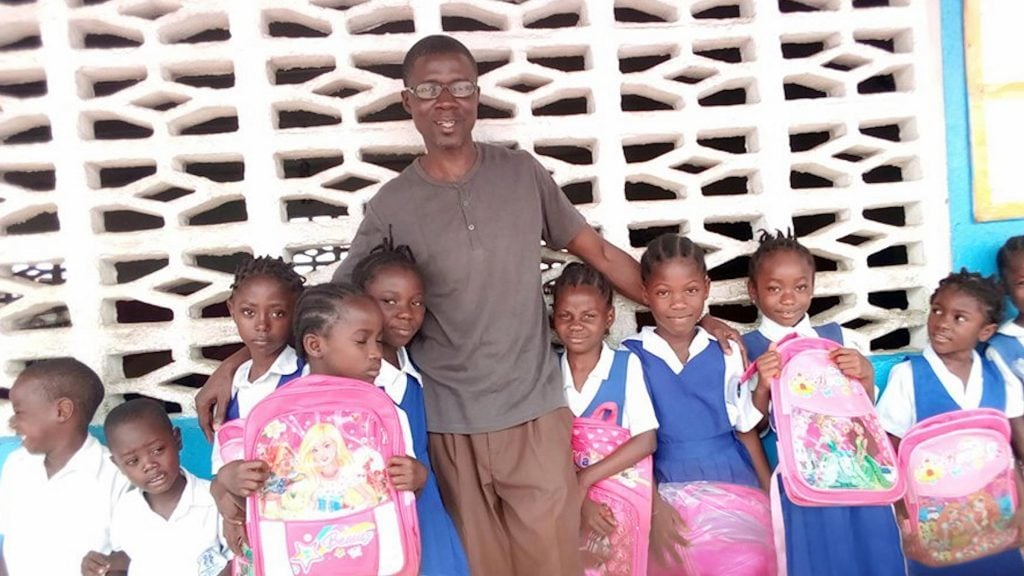
That is more than a year’s salary in Liberia. So Taylor didn’t really expect an unemployed, impoverished hustler to just give all that money away. Then another batch of pictures arrived. They showed smiling children with book bags and notebooks. Willie had bought out a market, rented a cab to haul the loot, and blessed five schools with abundance.

“He came through,” Taylor says. It was a revelation.

Taylor set aside his doubt and distrust, and then he did something else he never could have imagined a few months earlier: He traveled 6,500 miles to Monrovia, Liberia. He wanted to confront the man who’d tried to scam him, although confront probably isn’t the right word.

Willie says scam isn’t the right word either. He says he had just been looking to make a friend. But he also needed money.

By the time the two men finally met in person, he had found both. “We were business partners. And we were friends,” says Taylor.

Taylor expected that Willie would pocket all their sales money. Then this photo arrived. Courtesy Ben Taylor Taylor expected that Willie would pocket all their sales money. Then this photo arrived.

When he got to Monrovia, Taylor felt surprisingly at home. “I saw the places and the faces from the pictures Joel had sent,” he says. When he got to 
Willie’s street, he recognized it right away. He found his friend sitting outside his house, which was little more than cinder block walls, a dirt floor, and a tin roof. Inside were ­Willie’s wife and some of his seven children, who also greeted Taylor like an old friend.

Willie confessed to Taylor that he used to send Facebook messages to strangers, hoping to find some way a new friend would help him out of poverty. He said he was “more than desperate.”

“To feed the kids, a lot of things run into your mind,” Willie said. “Go and do this—the wrong thing.”

Fortunately, “By D Grace of God,” it never came to that. The booklets kept selling (8,000 at press time). People started taking pictures of themselves holding their copies and posting them on social media with the tag #bookofjoel. Soon Willie had new friends in more than 
40 countries, and Taylor’s fund-raising campaign had raised $12,000.

Some of the profits went toward Willie’s basic needs, such as a new roof to keep the rain out of his home. But the two men decided most of the money should be reinvested in the community.

Half the people in Liberia survive on less than $2 a day. Over the past 
20 years, the country has seen two civil wars and an Ebola outbreak that killed nearly 5,000 people in a nation of more than four million. Because need is every­where, Taylor and Willie decided to start with the most vulnerable and supplied five more schools with book bags, notebooks, and other necessities.

Taylor decided to tell their story in a second booklet, By D Grace of God: A True Story. Sales of both booklets total some $90,000 so far. And over the past year or so, with Taylor in Utah keeping track of the money and wiring it as needed and Willie the man on the street in Monrovia, they have done a lot more good. They paid the utility bills at one school and the teachers’ salaries at another that was about to close because its funding had dried up. For Christmas, Willie handed out care packages of used clothing to 500 kids—what he said they wanted most—and 25 bags of rice to needy families. They have begun mentoring entrepreneurs and making microloans of $50 to $100—a life-changing sum in Monrovia.

Willie’s street looked familiar to Taylor, thanks to all the blurry photos. Courtesy Ben Taylor Willie’s street looked familiar to Taylor, thanks to all the blurry photos.

Of course, the locals aren’t the only ones who have been changed by this unlikely partnership. Taylor says he’s no longer the cynic who started all this. “That’s just not me,” he says. “I’ve changed. I set out to embarrass a guy. I ended up helping a guy. I would much rather continue to help people. You feel good when you help others.”

As for Willie, he says he’s changed too. Although he still has to support his wife and kids on what many Americans spend at Starbucks, he says he’s OK using much of the money to help others. In fact, he says the opportunity to be charitable may be the best thing to come from all this.

“I used to receive,” Willie says. “I’m the one who’s giving now, and it’s better to give than to always receive.”

Did he ever consider keeping the $500? No, he says. “It’s stealing. And that would be dishonest. When you are truthful, when you are honest, you can come from nobody to somebody. I have come from zero to hero.”

Taylor has already been back to 
Liberia, and he says he plans to keep going, to keep helping. Because, as he says, “when you give someone a chance, sometimes they’re not who you thought they were. Sometimes they ­surprise you. And sometimes you end up being the answer to their prayers.”


JAMB to release 2019 UTME results Monday

April 28, 2019

JAMB to release 2019 UTME results Monday

dailytrust.com.ng

Apr 28, 2019 6:45 AM

The Joint Admissions and Matriculation Board (JAMB) has assured candidates of the 2019 Unified Tertiary Matriculation Examination (UTME) that results would be ready from tomorrow, April 29.

The Board’s Head of Media and Publicity, Dr Fabian Benjamin, disclosed this in an interview with the News Agency of Nigeria (NAN) on Saturday in Bwari.

Benjamin said that screening of the results would soon be over and the result released.

“We are still screening but hopefully, anytime next week, the results will be ready,” he said. (NAN)


About Us

Recent

Random